What is Fundamental Analysis?
Investors often rely on fundamental data, such as revenue growth rates or research and development outcomes, to gauge a company's potential as an investment. For instance, understanding a tech company's revenue growth, or a pharmaceutical company's progress in clinical trials, can provide insight into its intrinsic value.
Understanding Fundamental Analysis
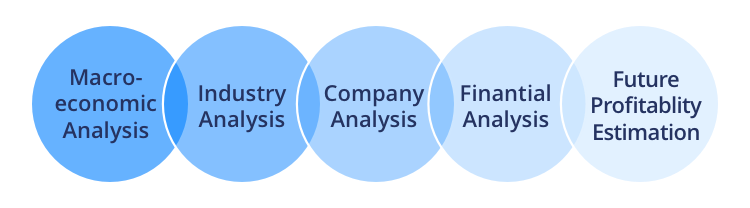
Fundamentals refer to the characteristics and financial data that indicate the stability and health of a company. These include macroeconomic trends, industry developments, and company-specific metrics. By analyzing these factors, investors can evaluate how changes in the business environment or company operations may impact performance and future stock prices.
For example, if an electric vehicle manufacturer consistently announces delivery delays, it might signal supply chain issues or technological challenges. Such news could cause investors to question the company's ability to scale production, which may result in a declining stock price.
Top-Down vs. Bottom-Up Fundamental Analysis
Fundamental analysis can be conducted using two primary approaches: top-down and bottom-up.
Top-Down Approach
- Analyzes macroeconomic factors, such as interest rates or GDP growth, to determine the overall state of the economy.
- Identifies which sectors or industries may offer the best investment opportunities. For example, cyclical industries tend to recover quickly during periods of economic growth.
- Narrows focus on specific industries and then on individual companies within promising sectors.

Bottom-Up Approach
- Focuses on individual stocks rather than general economic trends.
- Emphasizes microeconomic factors like a company's financial data and earnings.

Why Use Fundamental Analysis?
Fundamental Analysis aims to answer the question: How much is a company truly worth?
By calculating a company's intrinsic value using its fundamentals, investors can compare this value to the current market price to guide their decisions. Financial analysts build valuation models based on fundamental factors to help determine this. The idea is that over time, a security's price will move toward its intrinsic value.
Case 1: The intrinsic value is above the market price. It means the security is currently undervalued and could be added or increased within the portfolio.
Case 2: The intrinsic value is below the market price. It means the security is currently overvalued and should be reduced or removed from the portfolio. Some aggressive investors might even short sell the overpriced securities.
Quantitative and Qualitative Fundamentals
In his October 1967 letter to partners, Warren Buffett highlighted the importance of both quantitative and qualitative factors when evaluating securities and businesses.
To help better understand fundamental analysis, we can generally classify the fundamental factors into two groups: quantitative and qualitative.
Quantitative Fundamentals
- Represent numerical data, such as revenue, earnings per share (EPS), and profit margins.
- These metrics provide a measurable way to evaluate a company's performance and financial health.
Qualitative Fundamentals
- Represent non-numerical aspects, such as brand loyalty, management quality, or a company's reputation.
- These factors are harder to measure but can significantly influence a company's long-term success.
The Bottom Line
Fundamental analysis combines both quantitative and qualitative factors to assess a company's intrinsic value. By understanding these principles, investors can make informed decisions about whether to buy, hold, or sell a security. Whether using a top-down or bottom-up approach, fundamental analysis provides a structured way to evaluate potential investments.
Head to Webull Learn for more about Stocks, ETFs, Options, Bonds, and more. Webull is dedicated to improving your financial knowledge and helping you make more informed financial decisions.